All-on-4 Dental Implants: Who’s Actually a Good Candidate?

“I was told years ago I didn’t have enough bone for implants — does that still apply?”
This is one of the most common questions I get from patients considering full-arch tooth replacement, and the honest answer is: often, no, it doesn’t still apply. All-on-4 was specifically developed to work for patients who don’t qualify for traditional implants, which means a lot of people walking around with an old “you’re not a candidate” verdict are actually reasonable candidates today. Let me walk through who this treatment is actually designed for, who should think twice, and what the evaluation process actually looks for.
What All-on-4 actually is
All-on-4 replaces an entire arch of missing or failing teeth using just four strategically placed implants — two positioned vertically toward the front of the jaw, where bone is typically strongest, and two angled toward the back, which allows them to engage more available bone without needing to reach into areas that have thinned or receded. A full fixed prosthetic arch is then attached to those four implants, often on the same day as placement, giving patients a functional, fixed set of teeth immediately rather than a healing period spent without any teeth at all.
This is a fundamentally different treatment than replacing a single missing tooth or two. It’s designed for patients missing most or all of their teeth in an arch, or whose remaining teeth are failing beyond reasonable repair — not as an alternative to individual implants for a few scattered gaps.
Who tends to be a strong candidate
Patients missing most or all of their teeth in one or both arches. This is the core population All-on-4 was designed for — whether from years of untreated decay, advanced gum disease, trauma, or simply a lifetime of failing dental work that’s reached the end of what’s repairable. It’s also a common fit for patients currently wearing a removable denture who are tired of the instability, adhesive, and dietary restrictions that come with it.
Patients with thinning bone who were told traditional implants weren’t an option. This is the group most surprised to learn they qualify. Traditional implants typically need a fairly specific bone width and height at each individual tooth site. All-on-4’s angled posterior placement was engineered around exactly this limitation, which is why many patients who don’t have enough bone for conventional implants throughout the arch still have enough in the specific positions All-on-4 actually uses.
Patients in generally good health who don’t smoke, or are willing to quit. Healing and integration depend on adequate blood flow and immune function, which is why overall health matters as much as the condition of your jaw.
Patients ready to commit to the maintenance that comes with it. All-on-4 isn’t a “get it and forget it” treatment. Long-term success depends on consistent oral hygiene and regular professional maintenance, the same as any implant-supported restoration.
Did You Know
A retrospective cohort study tracking All-on-4 restorations found an implant survival rate of 98.2% and a restoration survival rate of 94.4%. These numbers reflect real-world outcomes, not just controlled trial conditions, and they’re a big part of why All-on-4 has become a standard option for full-arch tooth replacement rather than a niche alternative.
The bone myth, explained
The single biggest misconception I run into is patients assuming that because they were told years ago they had “too much bone loss” for implants, that verdict is permanent. In most cases, it was accurate for traditional implants at the time, and it simply doesn’t apply to All-on-4. The angled placement of the posterior implants was specifically designed to make use of denser bone that’s often still present even in jaws that have lost significant volume elsewhere — frequently avoiding the need for a bone graft that would have been required for a conventional approach. The angulation also allows each implant to be longer than a straight-down placement would permit in the same space, engaging more bone along its length and distributing biting forces more effectively across just four implants than four implants placed conventionally could achieve. That doesn’t mean every patient skips grafting entirely; some jaws are thin enough everywhere that additional bone is still needed. But it does mean the earlier verdict is worth revisiting rather than treating as final.
Who should think twice — or address something first
Uncontrolled diabetes. This doesn’t automatically disqualify a patient, but blood sugar that isn’t well managed significantly affects healing and integration. Getting it under control first meaningfully improves the odds of success.
Heavy, active smoking. The research here is specific: studies on implant failure rates have found smokers failing at roughly double the rate of non-smokers. Quitting, or at minimum significantly cutting back well before and after surgery, is one of the most direct ways to protect the investment.
Active, untreated gum disease. Placing implants into inflamed or infected tissue undermines the whole foundation. Gum disease needs to be brought under control before any implant surgery, not treated as an afterthought.
Certain medications affecting bone healing. Bisphosphonates, commonly used for osteoporosis, and some other medications can affect how bone heals around an implant. This isn’t an automatic disqualifier, but it requires a direct conversation with both your dentist and prescribing physician before moving forward. In some cases, coordinating timing with your physician, or adjusting the treatment plan around a medication history, is enough to move forward safely — the point is that it needs to be part of the conversation upfront, not discovered mid-treatment.
A history of radiation therapy to the jaw. Radiation affects blood supply to bone in ways that complicate healing, and patients with this history need a more careful, individualized evaluation, sometimes in coordination with the oncology team that managed their treatment.
Younger patients whose jaw is still developing. Implants need a fully mature jawbone to integrate properly, which generally means candidacy isn’t appropriate until jaw growth is complete, typically in the late teens to early twenties depending on the individual.
Patients who still have many healthy, functional teeth. All-on-4 is a full-arch treatment — it replaces everything in that arch, not just the compromised teeth. If most of your natural teeth in an arch are healthy, a more targeted solution, like individual implants or a partial restoration, is almost always the more appropriate choice.
Worth Knowing
Research on implant outcomes has found failure rates of roughly 15.8% in smokers compared to about 7.3% in non-smokers — more than double. If you smoke and are considering All-on-4, quitting before surgery is one of the single most impactful things you can do to protect the result.
What the evaluation actually looks at
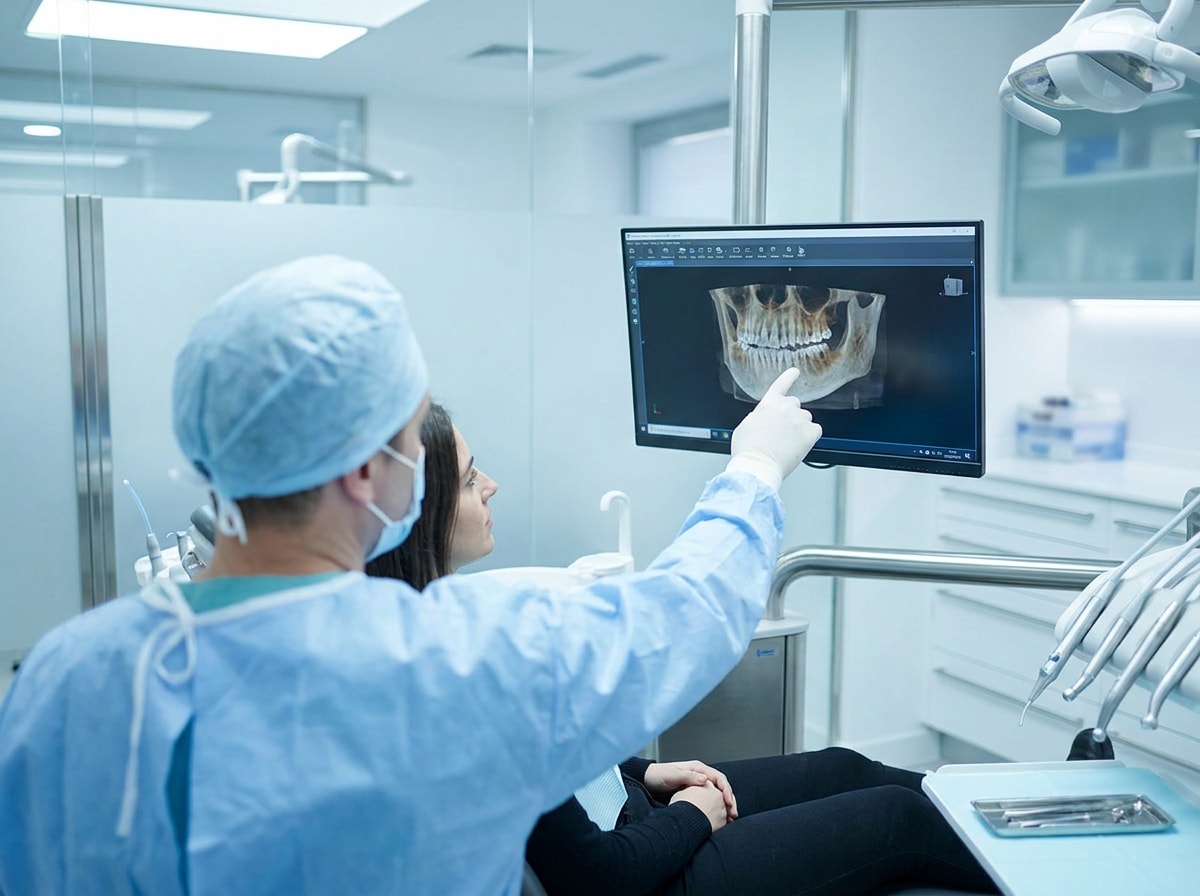
A real candidacy evaluation goes well beyond a visual look in your mouth. It typically includes a 3D CBCT scan to measure the actual width, height, and density of bone at each proposed implant site — not an estimate, but precise imaging that shows exactly what’s available to work with. It also includes a full review of your medical history and current medications, an assessment of any existing gum disease that needs treatment first, and a conversation about your specific goals, since “full-arch replacement” still leaves room for different approaches depending on what you’re trying to achieve.
Common questions that come up in a consultation
“How long does the whole process take, start to finish?” The surgery and temporary prosthetic typically happen in a single visit, but the complete timeline — through healing, integration, and the final prosthetic — usually spans several months. Patients function normally with the temporary restoration throughout that period, which is a meaningful difference from older approaches that left patients without teeth during healing.
| Option | Bone requirements | Stability | Timeline |
|---|---|---|---|
| All-on-4 | Designed to work with reduced bone via angled placement Often avoids grafting |
Fixed — does not come out, functions like natural teeth | Temporary teeth same day; final prosthetic in several months |
| Traditional multi-implant | Typically needs more bone volume at each site; grafting more common | Fixed once complete | Often longer, with healing before teeth are attached |
| Removable denture | Minimal bone needed Lowest upfront requirement |
Rests on gum tissue; can shift and requires adhesive | Fastest to obtain, but bone loss continues underneath over time |
“Will it hurt?” Discomfort after surgery is generally manageable with standard pain medication and improves significantly within the first week, similar to other oral surgery. Most patients describe the recovery as more manageable than they expected going in.
“Can I do just one arch, or does it have to be both?” Either is possible, and it depends entirely on which arch actually needs full-arch replacement. Plenty of patients have All-on-4 on the lower arch while keeping natural teeth, or a different restoration, on top, and vice versa.
“What happens to any teeth I still have in that arch?” They’re removed as part of the same procedure if they’re not salvageable, which is why a thorough evaluation of what’s actually failing versus what could be saved matters before committing to a full-arch approach rather than a more conservative option.
“Is this the same as a traditional denture?” No, and this distinction matters. A traditional denture rests on the gum tissue and can shift, click, or require adhesive. All-on-4 is fixed to implants anchored in bone — it doesn’t come out, doesn’t shift while eating or speaking, and functions much closer to natural teeth.
The maintenance commitment, specifically
Because All-on-4 is a bigger investment than a single implant, it’s worth being specific about what ongoing care actually looks like rather than leaving it vague. Daily cleaning involves brushing and using tools designed to clean underneath the fixed prosthetic, where food and plaque can accumulate in ways that differ from natural teeth. Professional maintenance visits are typically scheduled more frequently than a standard six-month cleaning, since monitoring the health of the gum tissue and the stability of the implants matters more with a full-arch restoration than with an isolated single tooth. Skipping these visits is one of the more common, and most preventable, reasons a well-placed All-on-4 restoration runs into trouble years down the line.
How All-on-4 compares to the alternatives
For patients missing most or all of their teeth in an arch, the realistic choices usually come down to All-on-4, more traditional multi-implant approaches, or a removable denture, and each trades off differently on cost, timeline, and daily experience.
What to actually expect
Most patients leave surgery the same day with a functional, fixed temporary prosthetic already in place — this is part of what makes All-on-4 appealing compared to older approaches that required months of healing before any teeth were attached. A final, more refined prosthetic typically follows several months later, once the implants have fully integrated with the bone. In the meantime, some dietary modifications — generally softer foods for the first several weeks — and a careful oral hygiene routine around the temporary restoration are part of protecting the investment during healing. Swelling and mild discomfort in the days immediately following surgery are normal and expected, and most patients are back to their regular routine within a week or two, even while the underlying integration process continues quietly for months afterward.
The bottom line
All-on-4 was built specifically for patients who don’t fit the mold traditional implants require — significant bone loss, a full arch of failing teeth, and a need for a fixed, immediate solution rather than a removable one. If you were told years ago that implants weren’t an option for you, that verdict deserves a second look rather than an assumption that nothing’s changed, especially given how much the technique and imaging technology behind it have advanced. The only way to know for certain is a real evaluation with 3D imaging, not a guess based on what you were told previously — and that evaluation is the actual first step, not a commitment to treatment.
Washington, PA & Pittsburgh
Wondering if All-on-4 is right for you?
Dr. Wakim can review your bone structure and dental history to tell you honestly whether you’re a candidate — including options if a previous evaluation said no.

Dr. Elizabeth Wakim, DDS, is the founder of Enhanced Wellness. She’s a compassionate and highly-regarded dentist with her own practice in Washington, Pennsylvania, known for providing modern, comprehensive dental care, botox and facial aesthetics with a focus on patient comfort and anxiety reduction, serving general, cosmetic, and pediatric dentistry needs.