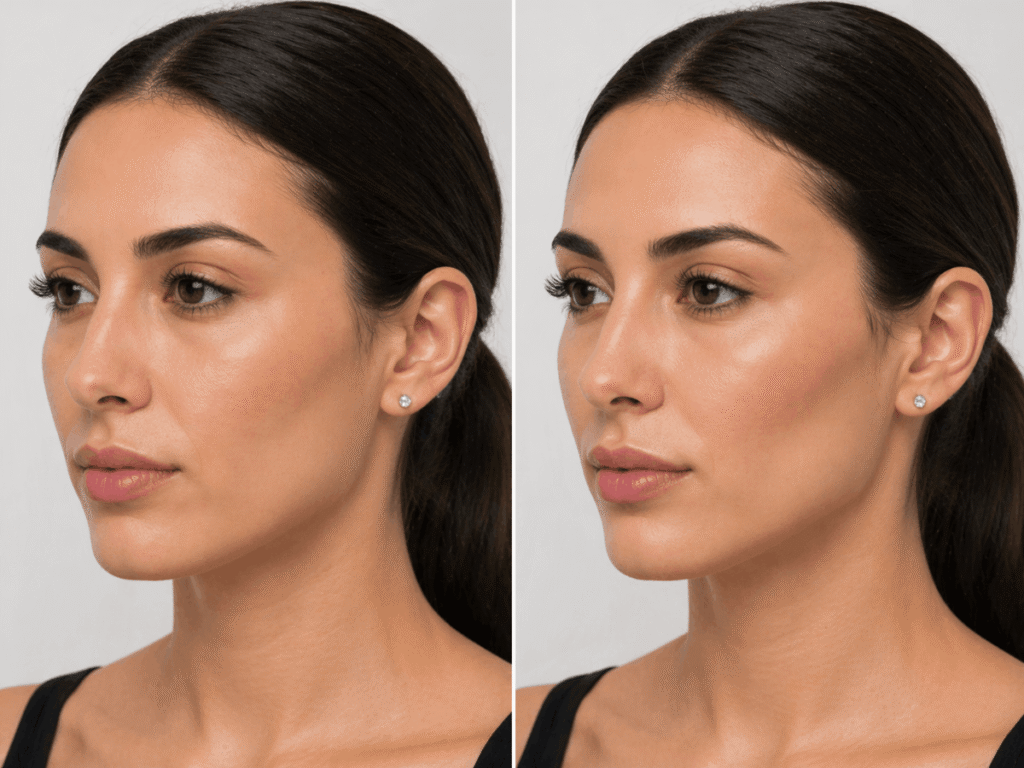
Cheekbone filler is one of the most-searched aesthetic treatments online, yet most of what comes up is photo galleries with little to no context.
What do the results actually look like on a real face? How much swelling should you expect? When does the filler settle? And is what you’re seeing in those before-and-after photos even realistic?
Below is an honest clinical breakdown of what cheekbone filler does, what the recovery actually looks like, and what results you can realistically expect based on your specific concern. No filters, no sales pitch.
What Is Cheekbone Filler and What Is It Actually Doing to Your Face?
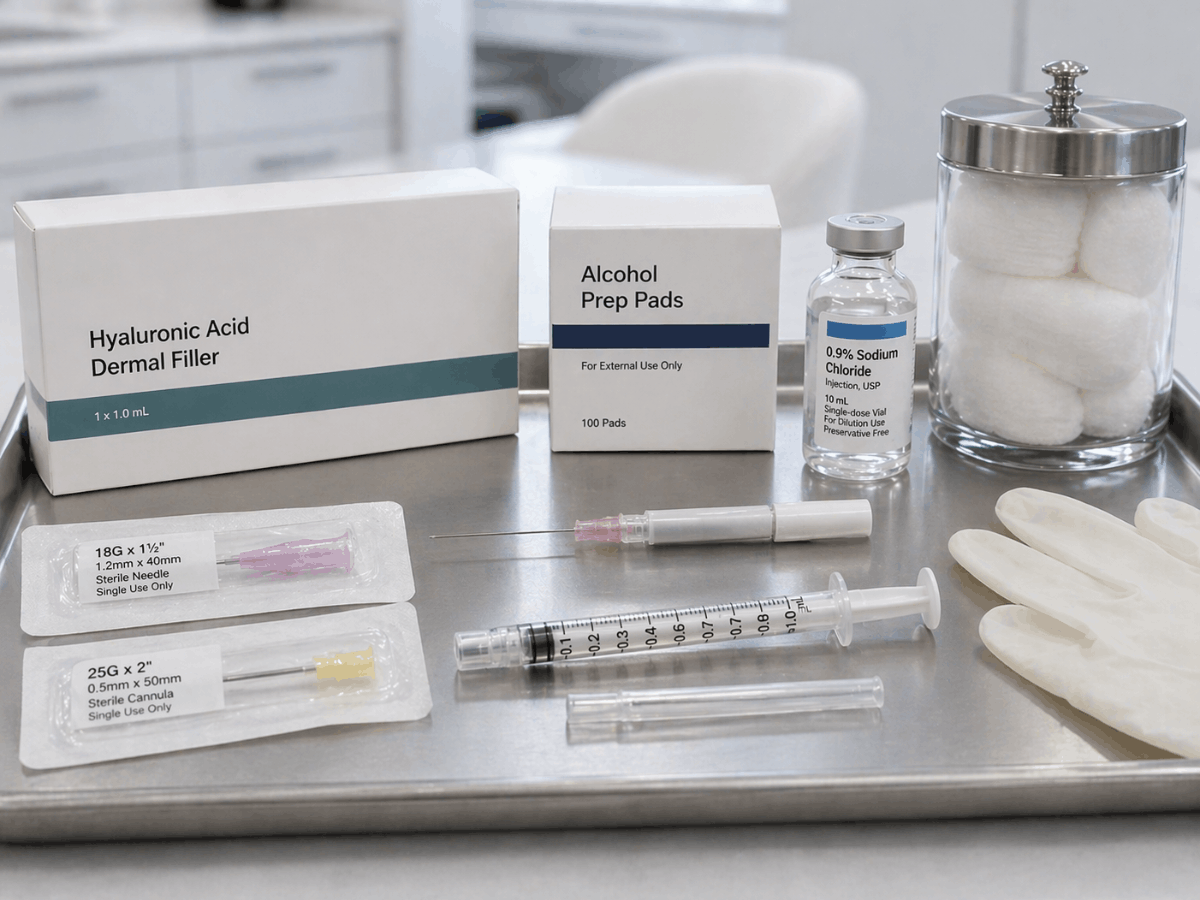
Cheekbone filler is a hyaluronic acid (HA) injectable placed along the malar region, the bony prominence that defines midface structure. Hyaluronic acid is a substance the body already produces naturally, which is why HA fillers are well-tolerated, adjustable, and fully reversible.
To understand what filler does, you need to understand what happens to the face over time. Starting in your mid-to-late 20s, the fat pads that give the cheeks their fullness begin to shift and thin. Bone density in the midface gradually reduces. Skin loses collagen. The result is not simply “getting older.” It is a structural change, and cheekbone filler addresses it at that level.
For patients who never had strong cheekbone definition to begin with, the clinical goal is different. Rather than restoring lost structure, filler is building it, adding projection and contour where the anatomy did not provide it.
Same product, same injection site. Completely different clinical goals, and as dermal filler results show, the difference in outcome is visible.
Who Is a Good Candidate? Hollow Cheeks vs. Age-Related Volume Loss
According to the American Society of Plastic Surgeons,dermal fillers remain one of the top five minimally invasive cosmetic procedures performed annually, yet cheekbone filler is not a one-size-fits-all treatment. The right candidate depends entirely on the underlying concern, and clinically, there are two distinct groups.
You’re Losing Volume You Once Had
If your cheeks looked fuller in your 30s and have gradually flattened since, that’s age-related volume loss. It’s not a skin issue and skincare alone won’t fix it. As the fat pads in the midface thin and shift over time, the face loses its structural support from the inside out. Cheekbone filler restores that projection and brings proportion back without altering your features.
Your Cheeks Have Always Been Flat
Not every patient is dealing with volume loss. Some simply never had strong cheekbone definition to begin with. Whether that’s due to genetics or body composition, filler here is about building contour the anatomy didn’t naturally provide, rather than restoring what was lost.
You Want to Soften Under-Eye Hollowing Without Tear Trough Filler
Under-eye hollows are not always a tear trough problem. When the midface loses volume, the transition between the lower eyelid and cheek becomes more visible, creating a tired, sunken appearance. Restoring cheekbone volume can soften that transition without injecting near the eye area, which carries a higher risk profile.
The concern drives the treatment plan. A provider who treats every cheekbone filler patient the same way is not approaching it correctly.
How Much Filler Do You Actually Need? 1ml vs. 2ml Explained
There is no universal amount. The right volume depends on your anatomy, the degree of volume loss, and the outcome you are trying to achieve. That said, the American Academy of Facial Esthetics notes that most cheek filler treatments typically range between 1 to 4ml per session, and there are general clinical benchmarks worth knowing before your consultation.
- 1ml Per Side: 1ml is the standard starting point for patients with mild volume loss or those new to cheekbone filler. It delivers a subtle but noticeable improvement in projection and lift. For younger patients with naturally flat cheeks seeking light definition, 1ml per side is often sufficient.
- 2ml Per Side: 2ml per side is appropriate for patients with moderate to significant volume loss, or those with pronounced hollow cheeks where a single milliliter would not adequately address the deficit.
Starting conservatively allows the filler to settle, gives both patient and provider a chance to assess the result, and reduces the risk of overfilling. Overfilling is significantly harder to correct than underfilling, and a balanced result at 1ml is always preferable to one that requires dissolving at 3ml.
More is not always better. A result that looks balanced at 1ml is always preferable to one that requires dissolving at 3ml.
What to Expect Before Your Appointment
Most patients focus entirely on the results and skip over everything that happens before the needle is even uncapped. The American Society of Plastic Surgeons recommends patients thoroughly research preparation protocols before any filler procedure, as what you do and don’t do before your appointment directly affects how your results turn out.
1. The Consultation Comes First
A provider should never schedule cheekbone filler without a consultation. This is where your facial structure is assessed, your concerns are documented, and a treatment plan is built around your aesthetic goals. During this visit, a qualified provider verifies your medical history, discusses the filler type best suited to your anatomy, and confirms whether FDA-approved products are appropriate for your specific case. Any clinic that skips this step and moves straight to booking is a red flag.
2. What Your Provider Should Be Assessing
A thorough assessment looks at the entire face, not just the cheeks in isolation. Lost volume in the mid face affects surrounding structures including nasolabial folds and smile lines, and precise placement depends on understanding how restoring lost volume in one area influences the rest. A provider needs that full picture before deciding where to add volume and how much filler treatment is appropriate.
3. What to Avoid Before Treatment
In the two weeks before your appointment, avoid blood thinners where medically safe. This includes aspirin, ibuprofen, fish oil, vitamin E, and alcohol. These increase bruising risk significantly. Most treatments also involve a local anesthetic to minimize discomfort, so disclose any known sensitivities along with all medications and supplements during your consultation.
4. Photos Will Be Taken
Before-and-after documentation is standard clinical practice. Photos are taken under consistent lighting before treatment and at follow-up, giving both patient and provider an objective reference point to assess cheek filler results accurately. This is also how your provider tracks collagen stimulation and skin rejuvenation progress over time, particularly relevant for patients dealing with sagging skin or loose skin alongside volume loss.
Coming in informed, including knowing what to do before and after your treatment, makes the consultation more productive and the treatment safer.
The Cheekbone Filler Before and After Timeline: What Actually Happens Day by Day
| Stage | What you will notice | Is this normal? |
|---|---|---|
| Day 1 | Swelling, possible bruising, overfilled appearance | Yes, do not assess results yet |
| Days 2 to 4 | Peak swelling, firmness, tenderness, asymmetry | Yes, expected and temporary |
| Days 5 to 10 | Swelling reduces, filler begins to soften and settle | Yes, early preview of results |
| Weeks 2 to 4 | Swelling fully resolved, results balanced and proportionate | Yes, this is your actual outcome |
| 3 to 6 months | Results stabilize, subtle continued improvement | Yes, most noticeable in volume loss patients |
This is the section most patients wish they had found before their appointment. Knowing what to expect at each stage is the difference between panicking at day two and understanding that what you’re seeing is completely normal.
Day 1: Immediately After Treatment
Swelling is present and, in some cases, significant. The treated area may look overfilled, uneven, or asymmetrical. Mild bruising is possible, particularly in patients who bruise easily or who could not avoid blood thinners before treatment. Do not assess your results on day one. What you are seeing is not your outcome.
Days 2 to 4: Peak Swelling
Swelling typically peaks around day two or three before it begins to subside. The cheeks may feel firm or tender to the touch and asymmetry during this window is common. This is temporary and resolves on its own as the swelling comes down.
Days 5 to 10: Settling Begins
Swelling starts to noticeably reduce. The filler begins integrating with the surrounding tissue and softening. Most patients get a preview of their actual results during this window, though the final outcome is not yet visible.
Weeks 2 to 4: Your Real Results
This is when a meaningful before-and-after comparison becomes relevant. Swelling is fully resolved, the filler has settled into the tissue, and results should appear balanced, lifted, and proportionate. If something looks off at this stage, this is the right time to follow up with your provider.
3 to 6 Months: Long-Term Outcome
Results stabilize and, in many cases continue to improve subtly as the structural lift supports surrounding tissue. Patients with age-related volume loss often notice the most meaningful long-term changes during this period.
The timeline varies between patients depending on metabolism, the amount of filler placed, and individual healing response. What does not vary is this: results at week one are never the full picture.
Cheek Filler Migration: What It Is, What It Looks Like, and How to Avoid It
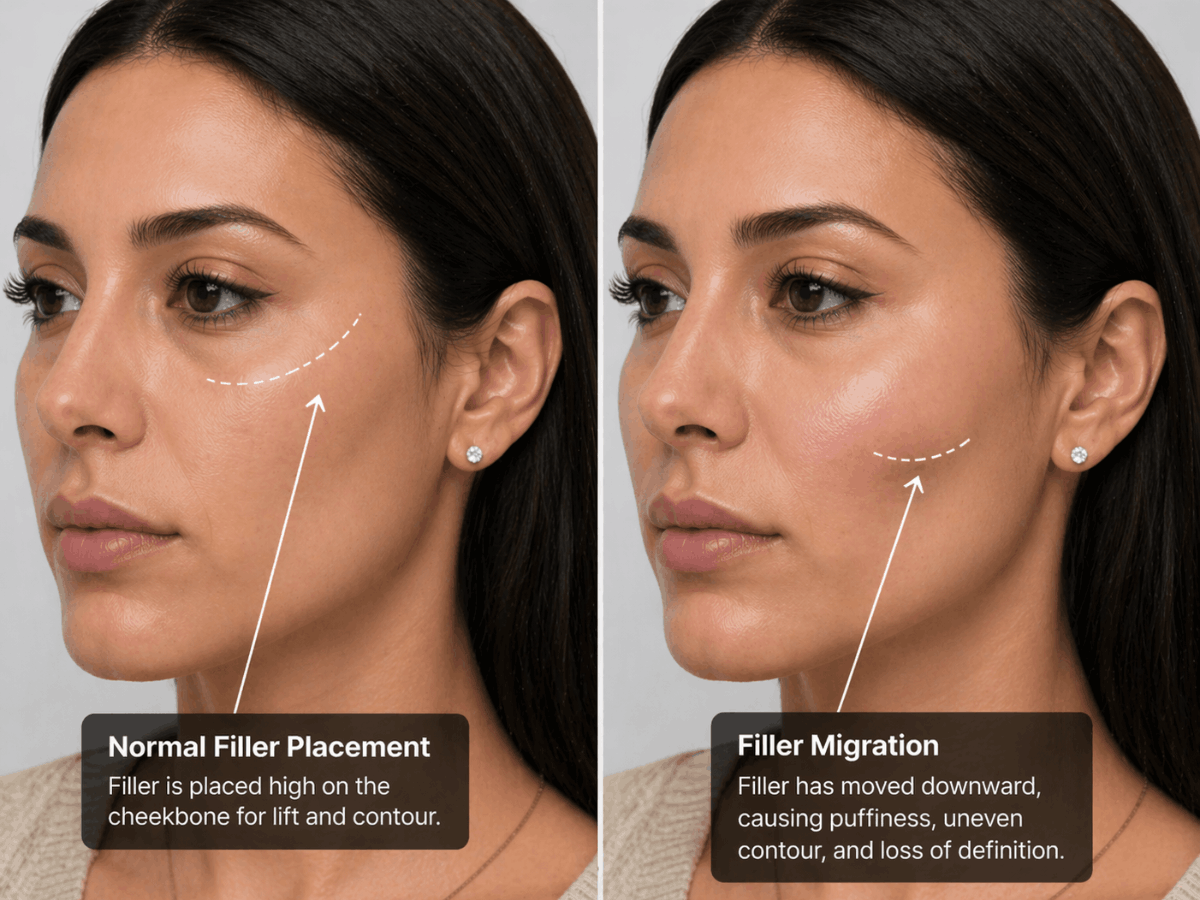
Filler migration is one of the most searched concerns around cheek filler, and also one of the most misunderstood.
What Migration Actually Is
Filler migration happens when the injected product moves from its original placement site to an adjacent area. In the cheek region this typically presents as puffiness or fullness in an unintended area, most commonly below the cheekbone rather than at it, creating a heavy or swollen appearance that does not resolve the way post-treatment swelling does.
What Causes It
Migration is most commonly the result of incorrect placement, too much product injected in a single session, or repeated filler layered over previous product without adequate assessment. It can also occur when filler is placed too superficially rather than at the deeper structural level where cheekbone filler belongs.
How to Spot It
Unlike normal swelling, migration does not resolve within two to four weeks. If fullness persists in an area that was not the intended treatment zone, or if the face begins to look heavy or disproportionate months after treatment, migration may be the cause. A follow-up with a qualified provider is the appropriate next step.
How It Is Prevented
The most effective prevention is choosing a provider with a thorough understanding of facial anatomy and a conservative approach to volume. Correct depth of placement, appropriate product selection, and not overfilling in a single session significantly reduce the risk.
Migration is not inevitable. In experienced hands it is uncommon.
Risks, Side Effects, and What a Qualified Provider Does Differently
Cheekbone filler is a low-risk procedure, but no injectable treatment is without potential complications. Knowing what is normal, what is expected, and what warrants a follow-up is part of making an informed decision.
Common and expected:
- Swelling, redness, bruising, and tenderness in the days following treatment
- Temporary asymmetry as swelling resolves unevenly
- Firmness or sensitivity at the injection site
These are normal responses to cheek filler treatment and typically resolve within one to two weeks. Most patients return to daily activity immediately, though the treated area may feel firm and look slightly uneven before it begins to smooth out.
Less common:
- Lumpiness or irregularity that does not resolve within four weeks
- Filler that feels uneven or sits outside the intended treatment area
When placed with precision, cheek filler treatment delivers a subtle lift and natural-looking results that restore youthful contour and defined cheekbones without surgery. Irregularities, when they occur, are most often the result of incorrect placement depth or too much volume added in a single session.
Rare but serious:
- Vascular occlusion occurs when filler enters or compresses a blood vessel, restricting blood flow to the surrounding tissue. This is among the most serious complications associated with any filler type
- Symptoms include sudden severe pain, skin blanching, or a bluish discoloration in the treated area. Any of the following treatments requires urgent contact with your provider
Serious complications are rare but they are real, and they underscore why provider selection matters as much as the treatment itself. Whether you are in Miami, New Jersey, or Pennsylvania, the standard of care should be the same: FDA approved products, a provider who understands facial balance, and a clinical environment equipped to handle complications if they arise.
An experienced provider minimizes risk through thorough anatomical knowledge, correct depth of placement, and appropriate product selection. They carry hyaluronidase on-site at all times, use the correct injection technique for the treatment area, and know when not to inject. Credentials, experience, and a conservative approach to volume are the most important factors a patient can evaluate before booking.
Know What You’re Walking Into
Cheekbone filler delivers real, measurable results when the right patient is treated by the right provider. The consultation, the credentials, and the clinical approach are not optional steps. They are what the outcome depends on.
At Enhanced Wellness, we take the time to assess your anatomy, understand your goals, and give you an honest picture of what treatment can realistically achieve for your face. Contact our Pennsylvania office at (724) 558-8222 or use our contact form to schedule your consultation.

Dr. Elizabeth Wakim, DDS, is the founder of Enhanced Wellness. She’s a compassionate and highly-regarded dentist with her own practice in Washington, Pennsylvania, known for providing modern, comprehensive dental care, botox and facial aesthetics with a focus on patient comfort and anxiety reduction, serving general, cosmetic, and pediatric dentistry needs.