Night Guards for Teeth Grinding: Custom vs. Over-the-Counter — Which Actually Works?
Custom or OTC nightguard — does it actually matter? Dr. Liza Wakim explains the real differences in fit, material, and protection, and when the drugstore option is and isn’t enough.
If you’ve been told you grind your teeth — or if you’ve woken up enough mornings with a sore jaw, sensitive teeth, or a dull headache to suspect it yourself — you’ve probably already found yourself in the nightguard aisle at the drugstore, staring at a wall of boil-and-bite options and wondering if any of them actually work.
The honest answer is: some of them do something. But what they do, and how it compares to a custom-fitted nightguard made by a dentist, is worth understanding before you spend money on either.
Here’s what I tell my patients.
What a nightguard actually does — and doesn’t do
First, a clarification that I find myself making regularly: a nightguard doesn’t stop grinding. It doesn’t retrain the jaw muscles, reduce the neurological drive to clench, or address the underlying causes of bruxism — which are typically a combination of stress, sleep architecture, and in some cases bite issues.
What a nightguard does is protect. It creates a barrier between the upper and lower teeth so that the force of grinding and clenching is absorbed by the guard rather than by the tooth surfaces and the temporomandibular joint. Think of it as a shock absorber rather than a cure.
This distinction matters because patients sometimes come in expecting a nightguard to fix their grinding. It won’t — but it will prevent the tooth wear, enamel erosion, and joint stress that grinding causes, which is the more immediately pressing clinical concern for most patients.
If you want to address the underlying muscle activity that drives grinding, that’s where a treatment like masseter Botox comes in — and I’ve covered that separately. A nightguard and Botox often work well together: the guard protects the teeth, the Botox reduces the force.
Over-the-counter nightguards: what you’re actually getting
OTC nightguards come in a few varieties — boil-and-bite thermoplastic guards that you soften in hot water and mold roughly to your teeth, pre-formed stock guards that don’t conform to your bite at all, and more recently, some mail-order options that use impression kits at home.
The best of these — a well-fitting boil-and-bite from a reputable brand — provides a genuine layer of protection between your teeth. For a patient with mild grinding and no significant jaw symptoms, it may be adequate, and I’m not going to tell someone that a $30 drugstore guard is worthless if it’s keeping their teeth from grinding against each other at night.
But there are real limitations that matter clinically:
Fit is imprecise. A boil-and-bite guard conforms approximately to the teeth, not precisely. The result is often a guard that doesn’t sit stably — it can shift during sleep, create uneven bite contact, or feel loose enough that patients take it out in the middle of the night without realizing it. A guard that comes out at 2am isn’t protecting anything.
Bite contact is uncontrolled. When you bite down on a custom nightguard, a dentist has equilibrated the surface so that your teeth meet the guard evenly across the arch. When you bite down on an OTC guard, the contact is whatever it happens to be — which can actually introduce new stress points that weren’t there before. For patients with significant TMJ symptoms, this is the most clinically relevant concern with OTC guards.
They’re often too thick or too soft. Many OTC guards — particularly the softer ones — are made from a material that actually invites more grinding, not less. The brain registers the soft, compressible material and responds by clenching harder into it. This is counterproductive, and it’s one of the reasons dentists generally recommend hard acrylic for nightguards rather than soft material for patients with significant bruxism.
Durability is limited. Heavy grinders go through OTC guards quickly — sometimes within weeks or a few months. A custom guard made from high-quality materials lasts considerably longer, making the cost comparison less straightforward than it appears on the shelf.
Custom nightguards: what makes them different
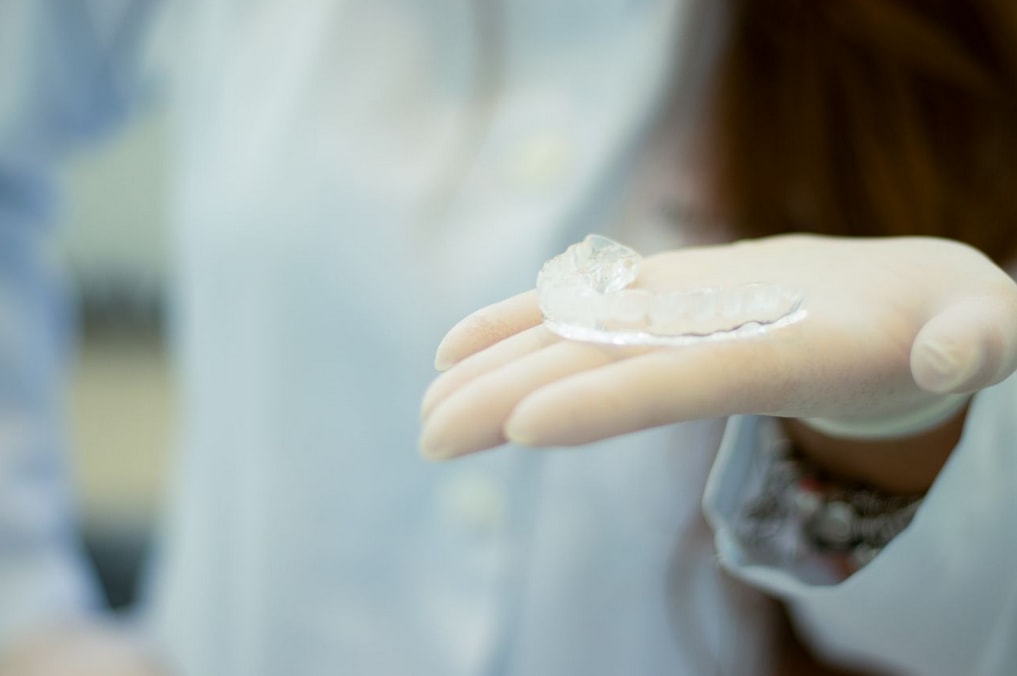
A custom nightguard is fabricated from an impression or digital scan of your specific teeth. It’s made from hard or semi-hard acrylic at a dental laboratory to precise specifications, and when it’s delivered, I adjust the bite surface so that your teeth contact it evenly and in a position that doesn’t stress the TMJ.
The differences that matter:
Precise fit. A custom guard fits your teeth exactly. It doesn’t shift, it doesn’t feel loose, and patients are far more likely to actually wear it consistently — which is, ultimately, the only metric that matters.
Controlled bite. The occlusal surface of a custom guard is designed so that your bite is balanced when you close onto it. This is what protects the joint, not just the teeth. For patients with TMJ symptoms, this is the meaningful clinical difference between a custom guard and an OTC option.
Appropriate material. I prescribe hard acrylic for most bruxism patients because it doesn’t invite further grinding the way soft material can. The material choice is based on your specific presentation — mild clenching patients may do well with a softer dual-laminate guard, while heavy grinders need hard acrylic.
Durability. A well-made custom guard typically lasts several years with proper care. Some patients have the same guard for five years or more. When the investment is spread over that timeline, the per-night cost comparison to OTC guards often flips.
| OTC nightguard | Custom nightguard | |
|---|---|---|
| Fit | Approximate — may shift during sleep | Precise — fabricated from impressions of your teeth Advantage |
| Bite control | Uncontrolled — can introduce uneven contact | Equilibrated — balanced bite across the arch Advantage |
| Material | Often soft — can trigger harder clenching | Hard acrylic or dual-laminate — chosen for your presentation Advantage |
| Durability | Weeks to months for heavy grinders | Several years with proper care Advantage |
| TMJ protection | Limited — bite contact is unmanaged | Meaningful — designed to reduce joint stress Advantage |
| Cost | Lower upfront — $20–$50 Advantage |
Higher upfront — lower cost per night over time |
| Best for | Mild grinding, no TMJ symptoms, interim protection | TMJ disorder, heavy grinding, existing restorations, long-term protection Recommended |
When OTC is a reasonable starting point
I’m not categorically opposed to patients trying an OTC guard before committing to a custom one — with caveats.
An OTC guard is a reasonable starting point if:
- Your grinding is mild and you have no significant jaw pain, headaches, or TMJ symptoms
- You want to confirm whether wearing a guard helps before investing in a custom one
- You’re waiting for a custom guard appointment and need something in the interim
- Budget is a genuine constraint in the short term
If you try an OTC guard and find you’re sleeping through the night with it comfortably, it’s helping your morning symptoms, and it’s holding up — that’s useful information. Come in, tell me, and we’ll assess whether upgrading makes sense.
When a custom guard is the right call
A custom nightguard is the appropriate choice when:
- You have documented TMJ disorder or significant jaw symptoms — pain, clicking, limited range of motion, frequent headaches
- You’re a heavy grinder who has worn through OTC guards quickly or damaged them significantly
- You’ve tried an OTC guard and found it uncomfortable, unstable, or unhelpful
- You have existing dental restorations — crowns, veneers, implants, bridges — that need protection from grinding forces
- You’re also receiving treatment for bruxism such as masseter Botox and want a complementary protective measure
- Your dentist has recommended one based on visible signs of grinding — worn enamel, flattened cusps, cracked teeth
A note on soft vs. hard guards
Patients sometimes request a soft guard because they assume it will be more comfortable. I understand the instinct — soft sounds gentler. But for most bruxism patients, the opposite is true clinically.
Soft guards are compressible, which triggers the brain to clench harder into them. They’re appropriate for patients who primarily clench without heavy grinding, and for patients who genuinely can’t tolerate a hard guard. For most heavy grinders, a hard acrylic guard is more protective and, after a brief adjustment period, just as comfortable to sleep in.
I make this decision based on your specific presentation — it’s not one-size-fits-all. But if you’ve been given a soft guard elsewhere and your symptoms haven’t improved, the material may be part of the reason.
How to care for a custom nightguard
A custom guard is an investment worth protecting. The basics:
Rinse it with cool water before and after each use. Hot water can warp the acrylic over time — always cool.
Clean it regularly with a soft toothbrush and mild dish soap or a dedicated guard cleaner. Toothpaste is too abrasive for most guard materials and can scratch the surface.
Store it in the case it came with — away from heat, pets, and curious children.
Bring it to your dental appointments so I can check it for wear and make sure it still fits correctly. Guards wear down over time, and a worn-out guard isn’t doing its job.
Ready to protect your teeth properly?
If you’ve been putting off getting a nightguard — or if you’re relying on an OTC option that isn’t fully doing the job — come in and let’s take a look. A properly fitted nightguard is one of the most straightforward, cost-effective ways to protect your teeth and your jaw from the long-term damage that grinding causes.
Serving patients in Washington, PA and the greater Pittsburgh area.
Washington, PA & Pittsburgh
Ready to get a nightguard that actually fits?
Dr. Liza will assess your grinding pattern, your jaw symptoms, and your existing dentistry — and fit you with a guard designed for your specific situation.

Dr. Elizabeth Wakim, DDS, is the founder of Enhanced Wellness. She’s a compassionate and highly-regarded dentist with her own practice in Washington, Pennsylvania, known for providing modern, comprehensive dental care, botox and facial aesthetics with a focus on patient comfort and anxiety reduction, serving general, cosmetic, and pediatric dentistry needs.