In-Office vs. At-Home Teeth Whitening: Which Actually Works Better?

“Should I just get the trays from you, or will the strips from the drugstore do the same thing?”
This is one of the most common cosmetic questions I get, and it deserves a more honest answer than “professional is always better.” The truth is more specific: in-office whitening, dentist-prescribed take-home trays, and over-the-counter strips all use the same basic chemistry, and the real differences between them come down to concentration, contact time, and supervision — each of which matters for a different reason depending on what you actually want out of the result.
Why your teeth are stained in the first place
Not all discoloration responds to whitening the same way, which is worth understanding before comparing methods. Extrinsic stains sit on the outer surface of the enamel and come from what you eat, drink, and use — coffee, tea, red wine, dark sodas, and tobacco are the most common culprits. These respond well to peroxide-based whitening because the pigment molecules are sitting right at the surface, within easy reach. Intrinsic stains live deeper, inside the structure of the tooth itself, and come from causes like certain antibiotics taken during tooth development, excess fluoride exposure as a child, trauma to a tooth, or simply the natural darkening that comes with age as enamel thins and the darker dentin underneath becomes more visible. Intrinsic stains respond to whitening far more slowly, if at all, and severe cases sometimes need veneers or bonding instead to achieve the color change a patient is actually looking for.
Knowing which type you’re dealing with changes the entire conversation about which whitening method — or whether whitening is even the right tool — makes sense for you.
The chemistry behind all of it
Every legitimate whitening method — in-office, custom trays, or drugstore strips — relies on the same active ingredients: hydrogen peroxide or carbamide peroxide (which breaks down into hydrogen peroxide once applied). These molecules penetrate the enamel and oxidize the pigmented compounds responsible for staining, breaking them into smaller, less pigmented pieces. Nothing physically “bleaches” your teeth the way bleach whitens fabric — it’s a genuine chemical reaction happening inside the tooth structure.
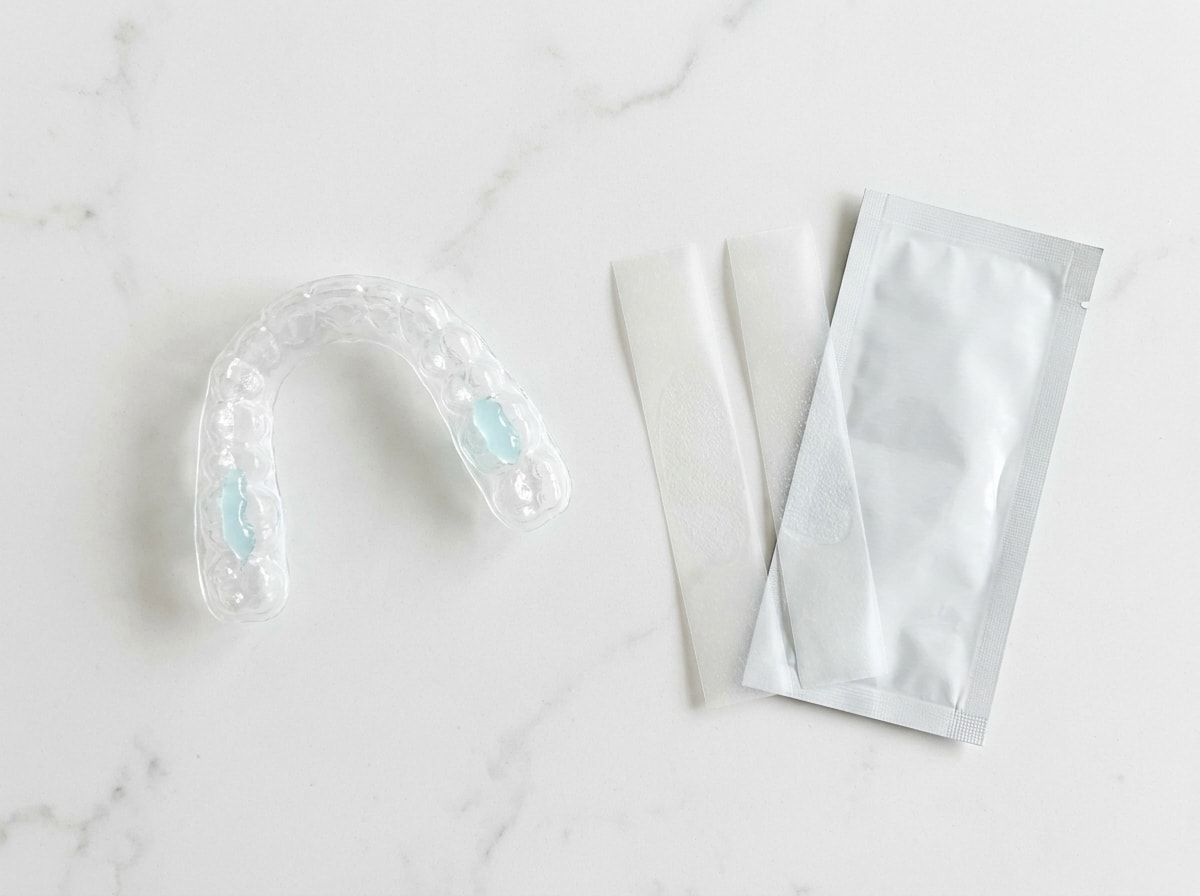
What differs between methods is almost entirely the concentration of that peroxide and how long it stays in contact with your teeth. In-office treatments typically use gels in the 25% to 40% hydrogen peroxide range, applied for 60 to 90 minutes under direct supervision. Dentist-prescribed take-home trays use a milder gel, usually 10% to 22% carbamide peroxide, worn nightly for one to two weeks. Over-the-counter strips sit at the lowest end, generally 3% to 10% hydrogen peroxide, and need four to six weeks of consistent use to reach a comparable result. I’ve written more on the underlying chemistry, including why some stains respond better than others, in Tooth Whitening 101.
So does higher concentration just mean better results?
Not quite, and this is where the research gets more interesting than the marketing suggests. A systematic review of professional whitening methods found that all approaches were effective at changing tooth color regardless of concentration or session length, and that at-home tray whitening actually showed lower recurrence of staining over time compared to in-office treatment. In other words, going stronger and faster doesn’t necessarily mean the result holds up longer — in some studies, the slower, lower-concentration approach held its color better months later.
There’s also a practical reason concentration doesn’t scale linearly with results: peroxide breaks down stain molecules, but a tooth’s “inherent lightness potential” — how light it can realistically get — has a ceiling. Past a certain point, more concentration mostly just means more speed and more risk of sensitivity, not a meaningfully different end result.
Did You Know
A systematic review of professional whitening research found that all methods were effective at changing tooth color, but at-home tray whitening showed a lower rate of staining returning over time compared to in-office treatment. Faster isn’t the same as more durable — the two approaches trade speed for longevity in different directions.
Where in-office whitening genuinely wins
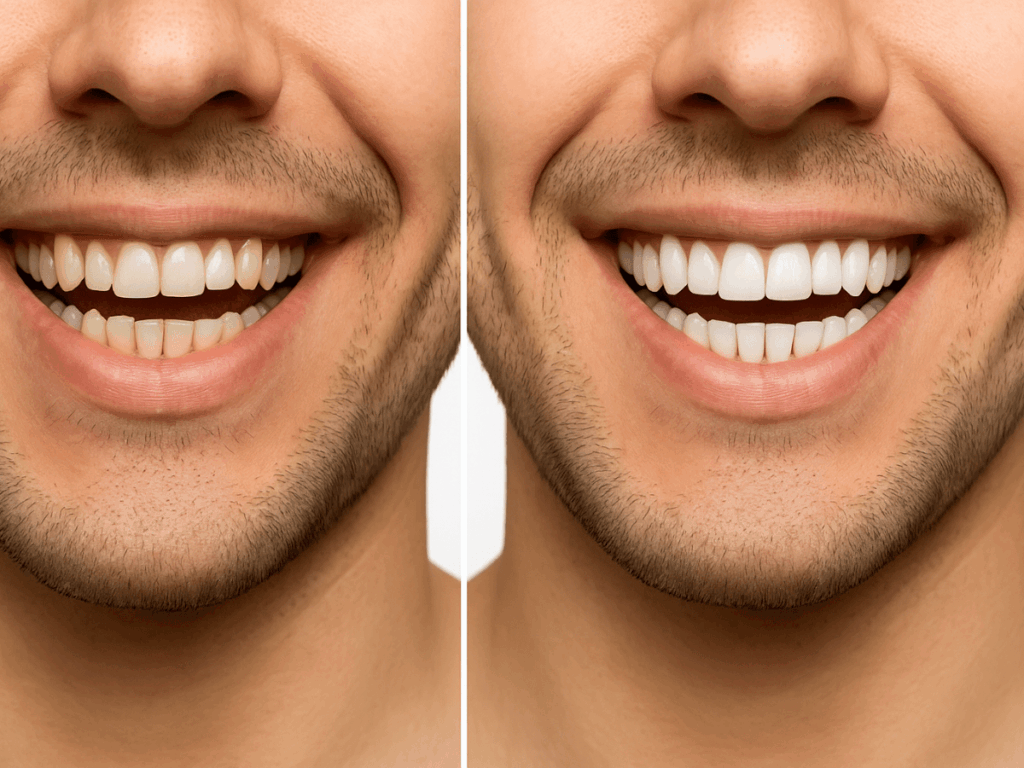
Speed. If you have an event, a wedding, or simply don’t want to commit to weeks of nightly trays, nothing else compares to walking out in one appointment with several shades of visible change.
Supervision and gum protection. At higher concentrations, direct contact with gum tissue can cause real irritation. In-office treatment includes a protective barrier over your gums specifically to allow the use of a stronger gel safely — something an over-the-counter strip simply can’t replicate.
Consistency of application. A dentist applies the gel evenly across every tooth. Generic strips and one-size-fits-all trays often fit imperfectly, which leads to patchy, uneven whitening and gel that leaks onto the gums.
Where take-home trays and OTC products hold their own
Custom trays reach comparable shades to in-office treatment, just over one to two weeks instead of one visit, and the research above suggests the results may actually hold up longer. For patients without a deadline, this is often the better value.
Lower concentration generally means less sensitivity. Since the gel sits at a lower strength and the exposure per session is shorter, take-home trays and OTC products are usually the gentler option for patients prone to sensitive teeth.
Touch-ups are simple and inexpensive. Once you own custom trays, refreshing your color after a stain-heavy holiday season or a few months of coffee is a matter of a few nights with a small tube of gel — no appointment required.
OTC strips are a reasonable entry point for surface stains, though they’re the slowest option and the ones most likely to fit imperfectly, which is where uneven results and gum irritation tend to come from.
The sensitivity trade-off
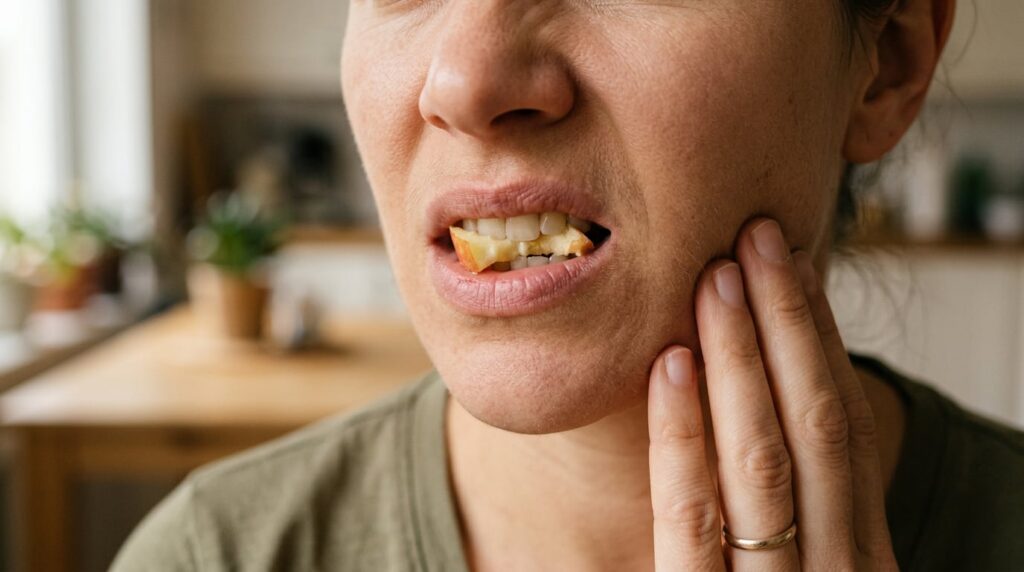
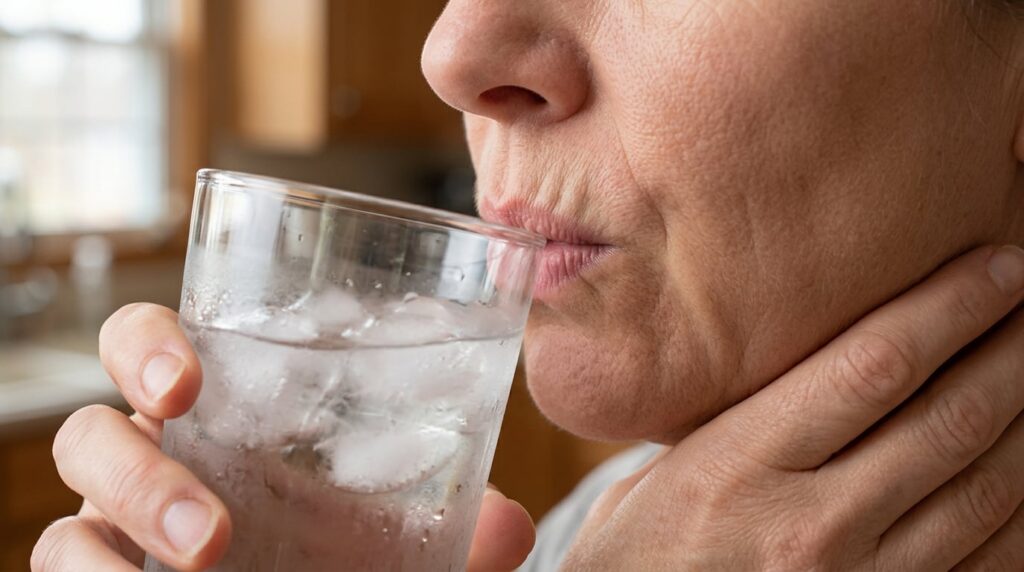
This is the part most patients underestimate going in. Whitening-related sensitivity happens because peroxide temporarily increases the permeability of your enamel, letting temperature and pressure reach the nerve more easily — and somewhat counterintuitively, sensitivity tends to be reported more often with in-office and combined treatments than with lower-concentration take-home options, according to the same body of research. It’s almost always temporary, typically resolving within a day or two as your enamel rehydrates and the protective layer covering it re-forms, but it’s worth knowing upfront rather than being surprised by it. If you already know you’re prone to sensitive teeth, using a desensitizing toothpaste with potassium nitrate for a week or two before starting either method can meaningfully soften the reaction when it happens. I’ve put together a full guide on managing sensitivity after whitening if you want the specifics on what actually helps.
Worth Knowing
Sensitivity after whitening tends to be reported more often with in-office and combined treatments than with lower-concentration take-home options — the exact opposite of what most patients assume going in. If sensitivity is a concern for you, that’s worth mentioning before choosing a method, not after.
What whitening can’t fix
Whitening only works on your natural tooth enamel — it does not change the color of existing crowns, veneers, fillings, or bonding, which means a whitened smile can end up with a visible mismatch between your natural teeth and any existing dental work. If you have visible restorations on your front teeth, that’s worth discussing before starting any whitening method, since the plan may need to include replacing or matching that work rather than whitening around it. Whitening also doesn’t work equally well on every type of stain — surface stains from coffee, tea, and wine respond well, but deeper, intrinsic discoloration from certain medications or developmental causes often needs a different approach altogether, like veneers or bonding. This is worth clarifying upfront, because a patient with intrinsic staining who tries several rounds of over-the-counter strips with minimal change isn’t doing anything wrong — they’re simply using the wrong tool for that particular type of discoloration.
Who should think twice before whitening
Pregnant or breastfeeding patients are generally advised to postpone cosmetic whitening — not because of strong evidence of harm, but because most dentists prefer to avoid elective chemical exposure during pregnancy when the treatment can simply wait.
Anyone with untreated cavities or active gum disease should address those first. Peroxide reaching an area of decay or exposed root through inflamed gum tissue can cause significant discomfort, and whitening over an active problem just delays noticing it.
Patients with visible restorations on their front teeth need a conversation before starting, for the mismatch reason described above — whitening a smile with an existing crown or filling in the direct line of sight can leave you with a visibly two-toned result.
Anyone with a known intrinsic staining cause, like tetracycline staining from childhood antibiotic use, should have a frank conversation about realistic expectations before investing in a whitening treatment that may only produce a modest change.
Can you combine both approaches?
Yes, and it’s a common strategy for patients who want the best of both worlds. Some patients start with an in-office treatment for a dramatic initial result, then maintain that shade over time with occasional touch-ups using custom trays at home — getting the speed of a professional treatment upfront without needing to return to the office every time the color starts to fade. Others do the reverse: starting with trays to gauge sensitivity and commitment before deciding whether an in-office boost is worth it for a specific event. There’s no single right sequence — it depends on your timeline, your sensitivity, and your budget.
What it actually costs
Cost varies by practice and geography, but the general pattern holds across most of the country: in-office whitening typically runs a few hundred dollars for a single visit, custom take-home trays are often a comparable or slightly lower one-time cost that then serves you for repeat touch-ups for years, and over-the-counter strips or gels are the cheapest per box but need to be repurchased every time you want to maintain results, which can add up over several years of consistent use.
| Stage | What’s happening | Treatment | Reversible? |
|---|---|---|---|
| White-spot lesion | Enamel demineralized but surface still intact — no hole yet | Fluoride varnish, prescription toothpaste, habit changes | Yes Best-case scenario |
| Enamel or outer dentin cavity | Surface has broken down into a physical hole | Filling — decayed portion removed, replaced with composite resin | No, but simplest fix at this point Most common |
| Extensive structural loss | Too much tooth lost for a filling to be reliable | Crown — full coverage restoration over the remaining tooth | No |
| Pulp involvement | Decay has reached the nerve and blood supply | Root canal, typically followed by a crown | No Needs prompt care |
| Advanced / unresolvable infection | Tooth structure or infection can’t be salvaged | Extraction, followed by a conversation about replacement | No Last resort |
How the three methods actually compare
Regardless of the timeline, the choice really comes down to how much you value speed and dramatic same-day results versus a more gradual approach with somewhat gentler sensitivity and, per the research above, a result that may hold its color longer.
Keeping your results once you have them
Whichever method you choose, the follow-up habits matter more than the method itself for how long the results last. Avoid heavily pigmented foods and drinks for the first 48 hours while your enamel’s protective layer re-forms, keep up with routine cleanings to prevent new surface staining from building up, and if you have custom trays, a quick touch-up every six to twelve months usually maintains your shade indefinitely without needing another full treatment. Rinsing with water after anything darkly colored, using a straw for drinks like coffee or dark soda, and keeping up with your regular oral hygiene routine all reduce how quickly new stains accumulate in between.
The bottom line
There isn’t a universally “better” option between in-office and at-home whitening — there’s a better option for what you’re optimizing for. If you need dramatic results by a specific date and don’t mind a higher chance of temporary sensitivity, in-office wins. If you’d rather ease into it, spend less per session, and possibly hold your color longer with milder sensitivity, custom trays are the better fit. Either way, this is exactly the kind of decision worth a quick conversation at your next visit — particularly if you have visible dental work on your front teeth, a history of sensitivity, or stains that might not respond to peroxide the way you’re expecting.

Dr. Elizabeth Wakim, DDS, is the founder of Enhanced Wellness. She’s a compassionate and highly-regarded dentist with her own practice in Washington, Pennsylvania, known for providing modern, comprehensive dental care, botox and facial aesthetics with a focus on patient comfort and anxiety reduction, serving general, cosmetic, and pediatric dentistry needs.